

| Photo | System requirements | |
 |
|
Operating systems: File formats: |
Building Services Planning in a Modern Guise – the TGA-Designer
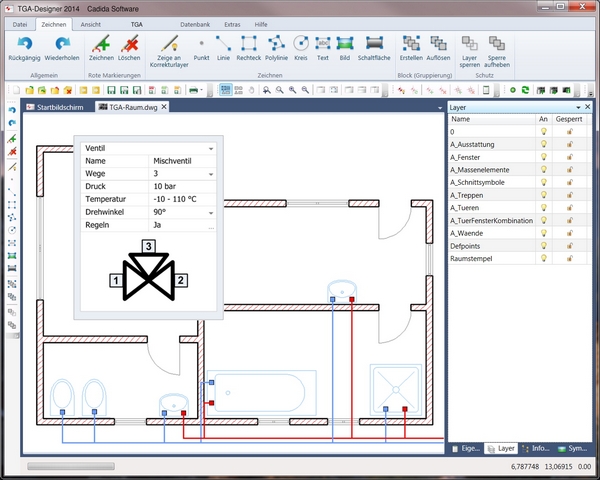
Planning work in the field of technical building services (German: "Technische Gebäudeausrüstung", TGA) is often based on CAD plans. However, CAD programs are very extensive and usually not specifically tailored to building services. Without in-depth knowledge of the CAD programs, it is not easy to continue working on the plans simply and intuitively. With the TGA-Designer, we offer a tool with which CAD plans can be read and edited for building services purposes. While the building services planning software does the calculations, the Designer takes care of the visual representation of the plan and the graphical representation of the results.
Attractive Views: Modern Visualisation for Your Familiar Software
The TGA-Designer is a display tool intended to improve the visualisation of your own software: it can be used to modernise the graphical representation of existing software and to improve the high-performance processing of even larger AutoCAD drawings.
This way, each side can concentrate on what it does best: one side provides its exclusive expertise for the necessary calculations, the other visualises the results clearly and prepares them in a user-friendly way.
What the TGA-Designer Can Do
Once the TGA-Designer has been started, existing CAD plans can be opened. A special feature is that the TGA-Designer also allows you to draw up new plans of your own. It thus even serves as a drawing program.
Existing building services objects such as valves, draw-off points, filters etc. can be inserted into the loaded CAD plans by drag & drop. Objects newly designed by the end user are not only displayed in the plans, but from then on are automatically available to all users in the catalogue window.
Rules for connecting objects enable quick and free design of networks. For example, objects "know" that they can be "connected" to other objects and suggest the corresponding action automatically.
Collaboration Made Easy
The edited plans can be sent as a PDF or image. By default, they are saved as DWG / DXF and can then be viewed and added to with, for example, AutoCAD or AutoCAD MEP.
So even if suppliers do not have the TGA-Designer, everyone can still work together on all plans without obstacles.
Interfaces – How the TGA-Designer "Talks"
The TGA-Designer can be addressed both via a supplied Windows service and via a .NET interface. These options make it possible to control all functions of the TGA-Designer.
A special service is that the software can also be extensively remote-controlled by other clients. For example, after a pipe network calculation, your program can automatically place the radiators on the drawing.
Further Modules: Space Management, GIS, Rights
With the space management module, dependencies not only of building services objects but of all objects (doors, windows, etc.) in the plan can be recognised and managed, so that conversions can be planned, for example.
In addition, the GIS module can be used to read geodata from the objects as soon as the building has been georeferenced. The georeferencing can be carried out directly in this module.
For collaboration between different user groups, the rights module lets you manage users' access rights: while one group can only view and comment, others are allowed to make changes to the plan.
Conclusion
The strengths of this program lie in its intuitive operation, even for inexperienced users, its user-friendly communication and the flexible applicability of the TGA-Designer, which allows extensive customisation.

 kununu